

Every impression happens somewhere: in an article, on an app screen, in the middle of a streaming programme. Contextual intelligence is the technology that understands that “somewhere” in the fraction of a second before an ad is served, and tells the advertiser whether it is the right environment for the message. From keywords to meaning Early contextual targeting matched keywords. It was fast but blunt: a keyword cannot tell a race report from an injury story. Modern contextual intelligence models meaning, turning the whole environment into a structured description that a buying system can price. The four signals it reads Topic: what the content is about, in specific terms. “Family travel planning”, not just “travel”. Tone: how it feels. A product launch and a product recall can share every keyword. Format: article, short video, live sport, game or series. Each changes attention and creative fit. Suitability: whether a brand should appear there at all. Safety is the universal floor; suitability is brand-specific. Why real time matters Content changes faster than any list. Real-time classification evaluates each impression as it happens: the programme and its audio-visual signals on CTV, the screen and moment in apps, the page rather than the domain on the web. Buyers price what the impression actually is, not what the site usually is. Five questions to ask a contextual partner Is classification done per impression, or per domain? Does it read audio and visuals, or text only? Is it aligned to an industry-standard taxonomy? Does it run before the bid? Is contextual data visible in your reporting? How MarkApp does it We don’t sell apps; we sell content environments. Pantheon, our contextual SSP, classifies environments in real time across CTV, app and web, using semantic and audio-visual signals on every bid. Harion activates campaigns on those signals across screens, and MarkDash makes them visible in reporting. The bottom line Context reflects what someone has chosen to read, watch or play right now. Contextual intelligence turns that into something a machine can price, and the best partners do it precisely, quickly and transparently. Talk to our team to see it on your inventory or campaigns. Frequently asked questions What is contextual intelligence? Technology that analyses the content around an ad, including its topic, tone, format and suitability, and turns it into signals used to decide where an ad runs and what the placement is worth. Does contextual intelligence work on connected TV? Yes. It reads the programme, genre and audio-visual signals, so ads can match the content being watched. What is the difference between brand safety and brand suitability? Brand safety avoids content no advertiser wants. Brand suitability matches each brand to the environments that fit its own values and goals.

Why the Ad Matches the Show: How Advertising on Streaming TV Works
You press play on a cooking show. The first ad break arrives, and the ad is for kitchenware. Coincidence? Usually not. Here is how streaming TV ads work, and what it means for you as a viewer. What is connected TV? Connected TV is any TV that streams over the internet: a smart TV, a streaming stick or box, a games console. Because ads arrive digitally, each break can be filled individually. On traditional TV, everyone watching a channel sees the same ad at the same time. What happens in a split second The break approaches. The streaming app knows an ad break is coming up. A request goes out, describing the programme, its genre and the length of the break. Advertisers respond. Automated systems decide instantly whether the break suits their campaign. The best fit plays, inserted smoothly into the stream. All of this happens before the first frame of the ad appears. Why the ad fits what you’re watching This is contextual advertising: matching ads to the content on screen. Watching a travel series? You are probably in the mood to think about trips. Live football? Sports gear and match-day food make sense. It works just like a magazine placing a cooking advert next to a recipe. What it means for you More relevant breaks that feel less like interruptions. Less repetition, because services can limit how often the same ad appears. More appropriate ads, suited to what is playing, especially during family viewing. Free or cheaper plans, funded by advertising. Where MarkApp fits MarkApp builds the technology behind these split-second decisions. Pantheon understands the programme, genre and moment in real time, so the ads that run fit the content around them. Harion helps advertisers reach the right environments on every screen. Our belief is simple: great advertising respects the content it appears in. Curious how it works behind the screen? Get in touch with our team. Frequently asked questions What is connected TV (CTV)? Any television that streams content over the internet, including smart TVs, streaming devices and games consoles. Why do streaming TV ads match what I’m watching? Many are chosen through contextual advertising, which looks at the programme and its genre to select a relevant ad. Do ads keep streaming services cheaper? Yes. Ad-supported plans are funded by advertising, which lets streaming services offer them free or at a lower price.

AI in Programmatic: What to Automate, and What Must Stay Human
AI now bids, paces, forecasts and reports at machine speed. The question for media leaders is no longer whether to use AI in programmatic advertising, but where to draw the line between what machines run and what people decide. The rule of thumb: automate decisions that are high-frequency, measurable and reversible. Keep human the decisions that are strategic, value-laden or hard to undo. What to automate Bidding and pricing: valuing each impression against live signals, in milliseconds. Pacing: thousands of small budget adjustments across markets and screens. Anomaly detection: catching spend spikes or delivery drops in minutes, not at month-end. Reporting: pulling and reconciling data, so analysts explain results instead of assembling them. What must stay human The objective: AI optimises what it is told to. Choosing the goal is strategy. Brand suitability: what a brand will appear next to is a judgement about values. Partners and supply: who to trust is a commercial and reputational decision. Accountability: a machine can make a decision; only a person can own it. Three failure modes to watch Proxy drift: optimising clicks or cheap reach instead of real business outcomes. Feedback loops: models learning from poor-quality inventory they bought earlier. Black-box acceptance: when no one can explain a decision, no one can catch a bad one. How to govern it Give every automated system a business goal, hard guardrails, a named reviewer, transparent reporting and an instant stop control. The more autonomy a system has, the clearer its boundaries must be, a shift we explored in From Buying Engine to Autonomous Operator. How MarkApp applies it Harion runs AI-driven bidding across web, app and CTV inside the guardrails each client sets. Pantheon applies AI to yield and real-time contextual classification, giving every model better inputs. MarkDash is the review layer, with transparent reporting and automated alerts on performance, spend and traffic quality. The bottom line The best programmatic operations will not be the most automated. They will automate the right things and stay deliberately human where it counts. Talk to our team to see how Harion and MarkDash keep automation fast and accountable. Frequently asked questions How is AI used in programmatic advertising? To price and bid on individual impressions, pace budgets, detect anomalies and automate reporting. Will AI replace programmatic traders? AI replaces repetitive execution, not judgement. Traders shift towards setting goals, guardrails and partner choices. How do you keep AI optimisation accountable? With a business goal, hard guardrails, a named human reviewer, transparent reporting and the ability to stop the system instantly.

How to spot AI-Generated junk online, and why it matters
You search for a recipe or a product review and land on a page that reads oddly: smooth sentences that say very little, the same point repeated, no author, more ads than paragraphs. You may have found low-quality AI-generated content, sometimes called “AI slop”. Here is how to spot it. Not all AI-generated content is junk Many reputable publishers use AI responsibly, with people checking the result and standing behind it. The problem is content mass-produced with no expertise, no editing and no accountability. Seven warning signs Lots of words, no useful detail. The same point repeated under different headings. No real author you can check. Images that don’t add up: warped text, odd details, or no link to the article. Ads everywhere, or constant pushes to click through to “the next page”. Facts that don’t check out. No date, sources or contact details. One sign proves little. Three or four together are a strong warning. Why it exists, and why it matters Mostly economics. AI makes pages almost free to produce, and every visit can earn advertising revenue, so some sites choose volume over quality. The result wastes your time, can mislead on topics like health or money, and pulls advertising money away from publishers who pay real writers and experts. What you can do Favour sources you trust, and bookmark them. Check the author and the date before relying on advice. Cross-check important facts with a second source. Support the publishers and creators you value. What responsible advertising does Responsible advertising technology checks the quality of the content around each ad before it is placed, so brands fund genuine content rather than junk. At MarkApp, Pantheon reads content environments in real time to help advertising reach quality environments, the principle behind The Curation Decade. AI has made content cheap to produce. That makes your judgement, and the choices advertisers make, more valuable than ever. Want to know more? Get in touch with our team. Frequently asked questions What is AI slop? An informal name for low-quality content mass-produced with AI tools to attract clicks and advertising revenue. Is all AI-generated content bad? No. The warning signs are a lack of expertise, editing and accountability, not the use of AI itself. Why do junk websites have so many ads? Advertising is how they make money. When content costs almost nothing to produce, every visit becomes an opportunity to show more ads.

Why QPS Management Is the Most Underrated Skill in Programmatic Operations
In programmatic advertising, performance conversations tend to begin with CPMs, fill rates, win rates, and revenue. Yet one of the most important decisions happens before any auction takes place: which bid requests should be sent in the first place? That is the role of QPS management. Queries per second, or QPS, represents the volume of requests flowing between programmatic platforms. At scale, exchanges and supply platforms process enormous volumes of opportunities across CTV, mobile app, and web environments. Sending more traffic, however, does not automatically create more value. Effective programmatic operations increasingly depend on identifying the traffic most likely to generate a meaningful outcome, and eliminating traffic that consumes infrastructure without creating sufficient commercial value. More QPS Does Not Mean More Revenue Historically, scale has been one of programmatic advertising’s defining advantages. More inventory created more opportunities to reach audiences, attract demand, and generate revenue. But unrestricted scale introduces inefficiency. When every available impression is routed to every eligible demand connection, platforms can generate significant volumes of requests with limited probability of receiving a bid. Infrastructure costs increase, demand partners receive unnecessary traffic, and potentially valuable supply becomes diluted within a much larger stream of low-performing requests. The objective should therefore not be to maximise QPS. It should be to maximise the value generated by each unit of QPS. This requires understanding performance at a granular level, including geography, device type, operating system, inventory source, format, bid floor, demand connection, historical bid behaviour, and profitability. QPS Management Is Ultimately Traffic Intelligence Sophisticated QPS management goes beyond applying static limits. Programmatic operations teams need to continuously evaluate which supply and demand combinations create value. A connection performing strongly for US CTV inventory, for example, may have completely different economics when receiving mobile app traffic from another geography. The operational question becomes increasingly specific: Which impression should reach which buyer, at what moment, and under what conditions? At MarkApp, this philosophy is reflected in the optimisation infrastructure supporting our programmatic ecosystem. Automated connection filtering can identify low-performing or non-profitable supply-demand combinations, while geo-prioritisation and floor-price optimisation help concentrate resources where stronger commercial outcomes are achievable. The result is a more disciplined supply path rather than simply a larger one. Less Traffic, Better Economics The impact of QPS optimisation can sometimes appear counterintuitive. Reducing traffic can actually improve performance. As Giannis Syropoulos, Chief Operations Officer at MarkApp, explains: “We reduced our outbound QPS by 35% and our win rate went up. Less is more when the traffic is right.” That principle captures an important shift in programmatic operations. Removing inefficient requests gives demand partners a cleaner, more relevant stream of opportunities. It can improve bid efficiency, reduce unnecessary infrastructure consumption, and create healthier commercial relationships between supply and demand platforms. For an exchange operating at scale, these efficiencies compound quickly. The Metric Behind the Metrics CPMs, fill rates, win rates, and revenue remain essential measures of programmatic performance. But they are downstream outcomes. QPS management influences what enters the auction environment before those metrics are generated. As programmatic infrastructure becomes more sophisticated, particularly across high-volume CTV, mobile app, and web environments, operational excellence will increasingly depend on intelligent traffic selection rather than unlimited traffic distribution. The next generation of programmatic optimisation will not simply ask how many opportunities a platform can process. It will ask how many of those opportunities were worth processing in the first place.

The Curation Decade: Why Premium Environments Beat Infinite Scale
Programmatic is done chasing volume. The next value pool belongs to curated, high-quality supply — and to the platforms that can prove what they are selling. For most of its history, programmatic advertising optimised for one thing: more. More impressions, more reach, more supply paths, more scale. That instinct built a vast market — and an enormous amount of waste. In 2026, the correction is well underway. Curation has moved from a niche tactic to a primary mechanism for how quality inventory is packaged, priced and bought. The industry is trading infinite scale for defensible quality, and the economics are following. What curation actually solves Curation is the practice of assembling premium inventory into targeted, high-value packages — bundling supply with contextual and quality signals so buyers can transact against environments they trust, at the source. Done well, it attacks the two diseases of open programmatic simultaneously: waste, by removing low-quality and misrepresented supply before the auction; and opacity, by making the composition of a deal legible to the buyer. The commercial logic is straightforward. When a buyer can be confident an impression is genuinely premium — the right environment, the right context, cleanly sourced — that impression commands a higher price and performs better. Curation raises effective yield for publishers and effective ROI for buyers at the same time. In a market drowning in undifferentiated supply, provable quality is the scarce asset. The end of the scale premium The structural driver is the collapse of the identity signals that once made vast, anonymous scale valuable. When you could target a user across millions of low-quality sites, breadth had a premium. As that targeting degrades, the value migrates back to the environment itself — to inventory whose context is known, whose quality is verifiable, and whose supply path is short. Scale without quality is now a cost, not an asset. Quality with context is where the margin lives. MarkApp’s curated model This is the market MarkApp was built to serve. Our operating principle — that we sell content environments, not apps — is a curation philosophy stated as positioning. Pantheon supplies the contextual intelligence that makes an environment legible: what a piece of inventory is, and why it is valuable, expressed as a real-time signal a buyer can act on. Curation is not a bolt-on for us; it is the design of the exchange. MarkDash closes the loop by making that quality visible. Curation only works if the buyer can verify what they bought, and transparency in reporting is what separates a genuine premium package from a repackaged commodity. Contextual curation on the supply side, proven through transparent reporting — that combination is difficult to replicate and precisely where independent, quality-led exchanges win. The strategic read Curation rewards the businesses that own their supply relationships and can substantiate their quality claims, and it punishes intermediaries who simply move volume. For advertisers, the mandate is to shift budget from open-market breadth toward curated, contextual packages where every impression is accountable. For the market, the direction is set: the next decade of programmatic value will be curated, contextual and transparent — or it will not command a premium at all.

The Transparency Dividend: What CTV’s Next Chapter Demands from Measurement
Connected TV is now the fastest-growing channel in digital advertising. Its biggest constraint is no longer supply or demand — it is trust. Connected TV has won the audience. More than two-thirds of television viewing now happens on streaming devices, and CTV is outpacing every other established digital channel, with the US market alone worth well above thirty billion dollars and still growing at double digits. The audience question is settled. The open question — the one that will decide how fast budgets follow the eyeballs — is whether buyers can trust what they are measuring. The measurement gap is CTV’s real ceiling CTV inherited television’s premium feel and digital’s accountability promise, but it has not fully delivered on the second. Fragmented measurement standards, walled-garden reporting, uneven identity signals and inconsistent definitions of a completed view have left buyers assembling incompatible numbers from incompatible sources. The result is a channel that everyone believes in and few can fully audit. That gap between conviction and verification is where budget hesitates. As identity signals degrade across the board, the instinct to lean harder on user-level attribution runs into the same wall CTV always faced: the durable cross-app identifier was never really there. The path forward is not more surveillance. It is better transparency — clearer, more consistent, more verifiable reporting of what actually happened in the campaign. Why transparency is now a commercial asset Transparency has quietly become a pricing input. When a buyer can see the supply path, verify the environment, and reconcile delivery against outcomes, they will pay more and commit more, because the risk premium they hold against uncertainty shrinks. When they cannot, they discount — or they retreat to the walled gardens, whose reporting they trust even when they dislike the terms. For independent platforms, transparency is not a compliance chore. It is the single most effective way to compete with the closed ecosystems for premium CTV spend. Where MarkDash comes in MarkDash is MarkApp’s answer to that trust gap: the reporting and operations layer that makes the entire transaction legible. It gives buyers and publishers a common, verifiable view of delivery, supply path and outcomes — the reconciliation that turns a plausible CTV buy into an accountable one. Paired with Pantheon’s contextual supply and Harion’s outcome-driven demand, MarkDash ensures that the intelligence in the buying and selling is matched by clarity in the reporting. This is the strategic point. In a market where every platform claims premium CTV inventory, the differentiator is not the claim — it is the proof. A contextual decision is only as valuable as a buyer’s ability to verify it delivered. Transparent measurement is what converts MarkApp’s contextual and agentic capabilities into trust, and trust into sustained, premium-priced demand. The takeaway CTV’s next chapter will not be won on inventory alone; that battle is largely over. It will be won on trust — on which platforms can prove, transparently and consistently, that premium environments delivered premium outcomes. The transparency dividend is real, and it accrues to the businesses that treat measurement as a product, not a footnote. That is the standard MarkApp is building to. MarkApp, We don’t sell apps. We sell content environments.

Privacy Sandbox Is Gone. Context Is What’s Left Standing.
Google retired its cookie replacement in late 2025. The lesson for the industry is not that identity survived — it is that context never depended on it. In October 2025, after six years and enormous industry investment, Google formally wound down Privacy Sandbox and abandoned its attempt to engineer a single, browser-led replacement for the third-party cookie. Third-party cookies remain in Chrome for now, governed by a vaguer “user choice” model, but the strategic message is unmistakable: the industry’s long bet on a clean, universal identity successor has failed. What endures is signal loss, fragmentation, and a buy side that still needs to perform. The identity era did not end — it fractured It would be a mistake to read the Sandbox’s demise as a reprieve for identity-based targeting. Cookies persist, but they are degraded, partitioned and politically fragile; the alternative ID graphs are fragmented across vendors and uneven across environments. In the two channels that matter most for growth — in-app and connected TV — the durable cross-site identifier barely existed to begin with. The addressable signal marketers relied on for a decade is not coming back in a unified form. That leaves a strategic vacuum, and vacuums in adtech are filled by whatever actually works at scale under the new constraints. Increasingly, that is context. Why context was always the more durable asset Contextual intelligence targets the content, not the person. It asks what an impression is — the genre, the mood, the subject, the brand-safety profile, the quality of the environment — rather than who is watching. That distinction is what makes it durable: it requires no consent gymnastics, survives every browser and platform policy change, and works identically in a cookieless app or a signed-in CTV app where user identifiers were never available. Modern context bears little resemblance to the crude keyword matching of a decade ago. AI-led contextual systems now read meaning, tone and narrative, aligning advertising with the emotional and thematic register of the content in real time. The industry’s own signals confirm the shift: several of the most-recognised new products in premium video this year are, at their core, contextual decisioning engines. The market has voted. Where Pantheon fits This is the environment Pantheon was designed for. As a contextual SSP for app and CTV inventory, it turns real-time understanding of the content environment into monetisation decisions on the sell side — no user identifier required. For publishers, that means yield that does not depend on leaking audience data to third parties. For buyers, it means precision in exactly the environments where identity signals are thinnest. The deeper point is strategic control. Platforms that built their value on borrowed identity signals are perpetually exposed to the next policy change from a browser or an operating system. Value built on understanding content is owned, defensible and compounding. Pantheon converts the collapse of the identity project from a threat into an advantage. The takeaway for the market The end of Privacy Sandbox should retire a comforting illusion: that someone, eventually, would hand the industry a like-for-like replacement for the cookie. No one will. The winners of the next cycle will be the businesses that stopped waiting and rebuilt their targeting on signals they actually control. Context is the most durable of those signals — and in app and CTV, it is not a fallback. It is the foundation.

From Buying Engine to Autonomous Operator: Why Harion Is Becoming an Agentic Commerce DSP
The demand side is entering its agentic era. The DSPs that thrive will set outcomes, not bids — and that shift changes what performance media can be. For fifteen years the demand-side platform has been, at its core, a very fast calculator. Buyers set rules, budgets and bid strategies; the machine executed them at scale. That model delivered efficiency, but it kept a human in the loop for every meaningful decision — and human bandwidth, not algorithmic capability, became the ceiling on performance. That ceiling is now lifting. The DSP is going agentic, and Harion is being rebuilt for it. What “agentic” actually means An agentic DSP does not wait to be told how to bid. It is given a commercial goal — a target return, a cost per acquisition, a revenue number in a given market — and it plans, executes, measures and re-plans autonomously to reach it. Instead of a trader adjusting fifty line items by hand, the system reasons across creative, audience, supply path and pacing, runs its own experiments, and reallocates budget continuously toward what works. The buyer moves from operating the machine to directing it. This is a genuine step change, not a feature. Rules-based automation optimises within boundaries a human drew. An agent redraws the boundaries when the data justifies it. The difference shows up as speed to signal, breadth of optimisation, and the disappearance of the manual work that consumes most trading desks today. Why agentic and commerce belong together The natural home for autonomy is commerce, where the objective is unambiguous and the feedback loop is short. When success is a sale rather than a soft proxy, an agent has a clean signal to optimise against and can be trusted with more of the decision. That is why Harion is evolving specifically into an agentic commerce DSP: purpose-built to connect media spend to commercial outcomes, and to close the loop between impression and transaction without a human re-tuning the campaign every morning. The market backdrop makes the timing right. Retail media is now the fastest-growing channel in digital advertising, and the industry is seeing the first signs of agent-driven commerce on both the buy and sell sides. An outcomes-native DSP is the correct instrument for that world — one that speaks the language of margin and conversion, not just impressions and clicks. The Harion transformation Harion’s evolution rests on three pillars. First, goal-based buying: partners express intent in commercial terms, and the platform composes the campaign to deliver it. Second, autonomous optimisation: continuous, self-directed testing across supply, creative and audience, with the agent promoting winners and retiring waste in real time. Third, a closed commerce loop: outcome signals feed directly back into decisioning, so every cycle starts smarter than the last. Crucially, autonomy is paired with control. Agentic does not mean opaque. Harion exposes its reasoning, its guardrails and its spend logic through MarkApp’s reporting layer, so partners retain strategic oversight even as the machine handles execution. The design principle is simple: maximum autonomy on the tactics, full transparency on the strategy. The strategic read For advertisers, the payoff is leverage — fewer people managing more spend at better outcomes, with the platform absorbing the operational load that used to require a full desk. For MarkApp, an agentic Harion working in concert with Pantheon’s contextual supply and MarkDash’s transparency creates a demand-to-supply loop that few independents can match: intelligent buying meeting intelligent inventory, measured end to end. The DSP is no longer just where media is bought. In its agentic form it becomes an autonomous commercial operator — and that is precisely the future Harion is being built to lead.

Pantheon Shortlisted for Best New Product at the 2026 European Video Awards
MarkApp is proud to announce that Pantheon, our real-time contextual decision engine for app and connected-TV inventory, has been shortlisted for Best New Product, as a platform reshaping programmatic CTV, at the 2026 European Video Awards, being recognised by VideoWeek Organised by VideoWeek, the EVAs are among the most rigorously judged honours in European video and CTV advertising, and the ceremony will take place in London on 1 October 2026. For a category defined by the platforms setting the direction of the market, the recognition is significant. It places Pantheon alongside some of the most established names in the streaming and exchange landscape, and validates a thesis MarkApp has argued from day one: in a post-identity market, the environment is the signal. The company we keep The Best New Product shortlist reads as a snapshot of where premium video is heading. Alongside Pantheon, this year’s finalists are Attekmi, recognised for AdEx Enterprise and its focus on scalable business expansion; FreeWheel, for its Context Engine bringing AI-driven contextual intelligence to premium streaming; Sabio, for the Household Graph unlocking the UK’s addressable TV potential; Index Exchange, for Index Cloud and its move to bring intelligence inside the exchange; and LightboxTV with Dentsu, for modernising TV planning workflows through frontsheet automation. It is a field with a clear centre of gravity. Four of the six finalists are, in one form or another, a bet on contextual and AI-led decisioning for television. That convergence is not a coincidence — it is the market telling us that identity-first targeting has reached its ceiling, and that the next decade of value will be built on understanding content, not chasing cookies. Why Pantheon Pantheon was built for the hardest problem in modern video: making a high-quality, privacy-durable decision in the milliseconds before a CTV or in-app impression renders, without depending on a stable user identifier. It reads the content environment — genre, mood, subject matter, brand-safety context and supply quality — and turns that understanding into a real-time monetisation decision on the sell side. The result is an SSP that behaves less like a pipe and more like an intelligence layer. Publishers gain yield without surrendering their audiences to third parties; buyers gain precision in environments where identity signals are thin or absent; and the whole transaction stays defensible under tightening privacy regimes. That is the edge the EVA jury saw, and it is the edge we intend to extend. What this means for our partners For MarkApp’s publisher and advertiser partners, the shortlist is more than a trophy shelf. It is external, independent confirmation that the contextual thesis is now mainstream — and that MarkApp is being measured against the largest platforms in the industry rather than in a category of its own. Recognition of this kind shortens sales cycles, strengthens partnership conversations, and signals to the market that premium, contextual CTV supply has a credible, independent home. We will share the outcome after the ceremony on 1 October. Whatever the result, being named among this group is a milestone we owe to every publisher, advertiser and team member who backed the idea that content environments — not identities — are the most valuable asset in video advertising. To our fellow finalists: congratulations, and see you in London.
The Burnout Nobody Talks About in Programmatic Operations
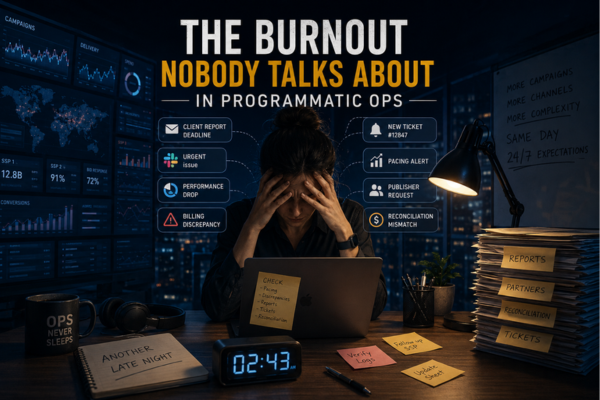
When people talk about burnout in advertising, they usually focus on sales teams, agencies, or creative departments. Rarely do they talk about the teams sitting behind the dashboards. The teams monitoring campaigns at midnight. The teams troubleshooting delivery issues before clients notice them. The teams reconciling data across multiple platforms, partners, and reports. Programmatic Operations has become one of the most critical functions in digital advertising, and one of the most demanding. The Invisible Work Behind Every Campaign Most successful campaigns share something in common: Nobody notices the operational work behind them. When everything runs smoothly: campaigns deliver, reports reconcile, budgets pace correctly, publishers monetize, advertisers achieve their goals. But achieving that consistency often requires continuous monitoring and intervention. Programmatic operations has evolved from campaign management into infrastructure management. Why Burnout Is Growing The challenge is not a lack of talent. The challenge is the increasing complexity of the ecosystem. Today’s operations teams manage: Multiple SSPs and DSPs CTV, mobile app, and web environments Supply path optimization initiatives IVT monitoring Financial reconciliation Reporting requests Technical integrations Platform troubleshooting At the same time, expectations continue to rise. Everything must happen: faster, more accurately, and with complete transparency. The Problem Isn’t Workload — It’s Fragmentation Most operations professionals are not overwhelmed because they work hard. They are overwhelmed because information is fragmented. A typical day often involves switching between: DSP dashboards SSP reports Billing spreadsheets Slack messages Email threads Platform tickets Publisher requests Client updates The result is operational fatigue caused by constant context switching. The Cost of Operational Burnout Burnout doesn’t only impact people. It impacts performance. When teams spend their time manually collecting information instead of making decisions, organizations experience: Slower optimization cycles Delayed issue detection Reporting inconsistencies Reduced efficiency Higher operational risk The industry often talks about media efficiency while overlooking operational efficiency. The two are directly connected. The Industry’s Next Challenge: Operational Scalability As programmatic continues to grow, scalability is no longer only a technology problem. It is an operational problem. Companies can add: more inventory, more partners, more campaigns, and more markets. But eventually, operations teams become the bottleneck if processes remain manual. The next phase of growth requires reducing complexity, not adding more of it. People Are Part of the Infrastructure Technology often gets the spotlight in programmatic advertising, but operational resilience is built by people. Behind every campaign launch, troubleshooting request, reporting cycle, and optimization decision are teams working across multiple platforms, time zones, and stakeholders to keep the ecosystem running smoothly. As the industry continues to scale, organizations must focus not only on platform performance, but also on creating sustainable operational environments for the teams managing them. Giannis Spiropoulos, Chief Operations Officer at MarkApp, commented: “In ops, we celebrate speed and uptime. We should also celebrate the team structures that make both sustainable.” The future of programmatic operations is not only about automation and efficiency. It is also about building processes, systems, and teams that can scale without sacrificing performance or well-being. How Automation Changes the Equation The most effective operations teams are shifting from manual workflows to intelligent automation. The goal is not replacing people. The goal is allowing people to focus on decisions instead of administration. Automation can help with: Alerting and anomaly detection Reporting consolidation Billing workflows Performance monitoring Reconciliation processes This transforms operations from reactive management into proactive optimization. How We Approach Operations at MarkApp As our global activity across CTV, mobile apps, and web continues to grow, we have learned that operational efficiency is just as important as media efficiency. This is one of the reasons we built MarkDash. By centralizing reporting, analytics, alerts, and operational workflows into a single environment, we aim to reduce fragmentation and provide teams with a single source of truth. The objective is simple: Less time searching for information. More time making decisions. What Comes Next The future of programmatic operations will not be defined by who can manage the most dashboards. It will be defined by who can eliminate the need for them. The companies that invest in operational intelligence, automation, and workflow simplification will be better positioned to scale efficiently while maintaining quality and transparency. Final Perspective Programmatic advertising has spent years optimizing media buying. The next opportunity is optimizing the people and processes behind it. Because the burnout nobody talks about isn’t caused by the volume of campaigns. It’s caused by the complexity required to manage them. And solving that challenge may become one of the most important competitive advantages in AdTech.
The Rise of Curated Programmatic: Why Quality Is Replacing Scale
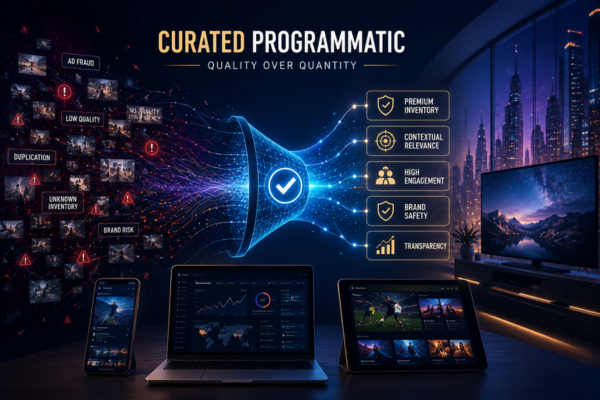
Curated programmatic marketplaces are reshaping digital advertising by prioritizing quality, transparency, and performance across CTV, mobile apps, and web environments. Introduction For years, programmatic advertising was driven by one primary objective: scale. The industry focused on accessing more inventory, more impressions, and more reach. But as supply chains became increasingly complex, advertisers began asking a different question: “Are we buying better media, or simply buying more media?” In 2026, the conversation is shifting from scale to quality, driving the rapid growth of curated programmatic marketplaces. The Problem with Unlimited Scale The programmatic ecosystem has matured significantly, but several challenges remain: Supply-path complexity Inventory duplication Limited transparency Inconsistent traffic quality Growing pressure on media efficiency As more intermediaries enter the supply chain, advertisers often struggle to understand exactly where budgets are being allocated and what value is being delivered. This has created demand for a more controlled approach. What Is Curated Programmatic? Curated programmatic combines technology, inventory intelligence, and strategic packaging to create more valuable buying environments. Instead of accessing millions of impressions indiscriminately, advertisers gain access to inventory selected based on factors such as: Content quality Audience relevance Contextual suitability Traffic quality Performance characteristics The goal is not to reduce scale. The goal is to improve efficiency. Why Agencies and Brands Are Embracing Curated Supply Today’s media buyers are increasingly focused on: Supply-path optimization (SPO) Premium inventory access Better CPM efficiency Brand safety and suitability Outcome-driven media buying Curated marketplaces help eliminate unnecessary layers while creating stronger alignment between inventory quality and campaign objectives. The Growing Role of Contextual Intelligence As identity signals become less reliable, contextual intelligence is becoming a critical component of curation. Understanding: content, environment, audience mindset, and engagement potential is often more valuable than relying solely on user-level identifiers. This is especially true across: Connected TV Mobile apps Premium publisher environments where context directly influences performance. How MarkApp Enables Curated Programmatic Pantheon – Contextual Curation Infrastructure Pantheon was built to enhance inventory before auction execution through: contextual classification engagement scoring content intelligence environmental signals This enables the creation of highly curated supply packages designed around quality and performance. Harion DSP – Smarter Demand Activation Harion DSP enables advertisers and agencies to activate curated inventory through: omnichannel campaign execution cross-device targeting flexible buying models performance optimization ensuring buyers can align media investment with measurable business outcomes. MarkDash – Transparency and Operational Control MarkDash provides: unified reporting real-time analytics supply-path visibility optimization insights allowing partners to understand exactly how curated inventory performs across channels. The Business Impact Curated programmatic delivers several advantages: Higher-quality inventory access Reduced supply-chain inefficiencies Improved campaign performance Greater transparency and control Stronger advertiser confidence The result is a more efficient marketplace where value is created through intelligence rather than volume. What Comes Next The future of programmatic will not be defined by who has access to the most inventory. It will be defined by who can identify, package, and activate the most valuable inventory. As the market continues to prioritize transparency, efficiency, and outcomes, curated programmatic is becoming one of the most important trends shaping the future of digital advertising. Final Perspective The industry is moving away from the idea that more impressions automatically create better results. The next generation of programmatic advertising is built around precision, quality, and intelligence. In that future, curation becomes more than a marketplace strategy — it becomes a competitive advantage.