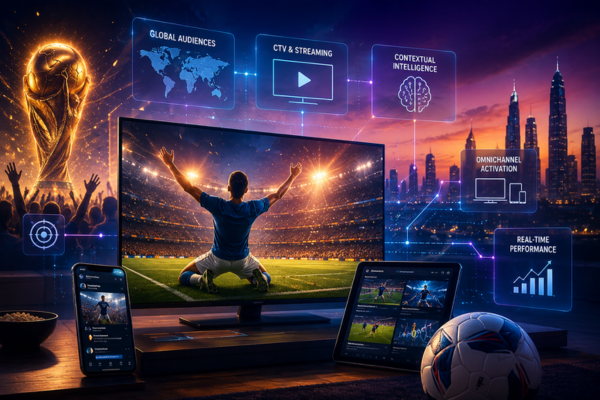
The 2026 World Cup is the largest single advertising window in history , a 39-day surge across three host nations, sixteen host cities, and a global audience watching on more screens than any tournament before it. Analysts project the event will add roughly $10.5 billion in global ad spend in the quarter it takes place (InternetRetailing, Digital Yield Group).
But the headline number hides the more important story. The money is moving, out of linear broadcast and into connected TV, programmatic, contextual targeting and retail media. For brands without official sponsorship rights, that shift is not a complication. It is the opportunity.
The center of gravity has moved to CTV
Connected TV is no longer the secondary screen. Streaming now accounts for 47.5% of all US TV viewing time (Nielsen, December 2025), and among adults 18–49, the demographic advertisers compete hardest for — it represents two-thirds of all ad-supported viewing. CTV ad spend is projected to reach $37.95 billion in 2026 (eMarketer), nearly double the figure from two years earlier.
The performance case is just as clear: ads in live sports on CTV have been shown to deliver up to 66% higher effectiveness than cable and broadcast averages. With premium tournament inventory commanding streaming CPMs reported as high as $120, efficiency is no longer a nice-to-have , it is the difference between a campaign that scales and one that burns budget in the group stage.
The signal for marketers is simple. A World Cup video strategy that treats streaming as an afterthought for younger viewers is already behind the market.
Fragmentation is the defining challenge
This tournament does not land in one country with one audience. It lands in sixteen distinct city markets across the US, Canada and Mexico, each with its own language mix, cultural identity and fan behaviour. At the same time, attention itself is splitting across devices: 56% of fans now use a second screen while watching sport, and consumers are 49% more likely to purchase when they encounter a brand consistently across CTV, social and mobile (Digital Yield Group).
The implication is uncomfortable for anyone still planning around a single national spot buy. Reach without coherence is wasted spend. The brands that win the 2026 window will be the ones that follow the viewer, from the live match into highlights, second-screen browsing and the retail environments where intent converts, with a consistent message and a single view of performance.
Why contextual beats identity in a privacy-first tournament
Here is the structural tension underneath every World Cup media plan: the audience has never been more reachable, and third-party identity has never been less reliable. The cookieless shift, tightening privacy regulation and the sheer scale of cross-border, multi-language streaming make user-level targeting both harder and riskier exactly when precision matters most.
Contextual intelligence is the answer the market is converging on. Rather than chasing a fragile user ID across screens, contextual activation reads the content, the moment and the attention around the ad, football coverage, match analysis, host-city editorial, sports apps, and places the brand where relevance is highest. It works post-cookie, it works across borders, and it works in CTV environments where deterministic identity barely exists. As one programmatic analysis put it ahead of the tournament, World Cup advertising is becoming increasingly dynamic and contextual, and the brands that adapt message and format to each moment of consumption will hold the advantage.
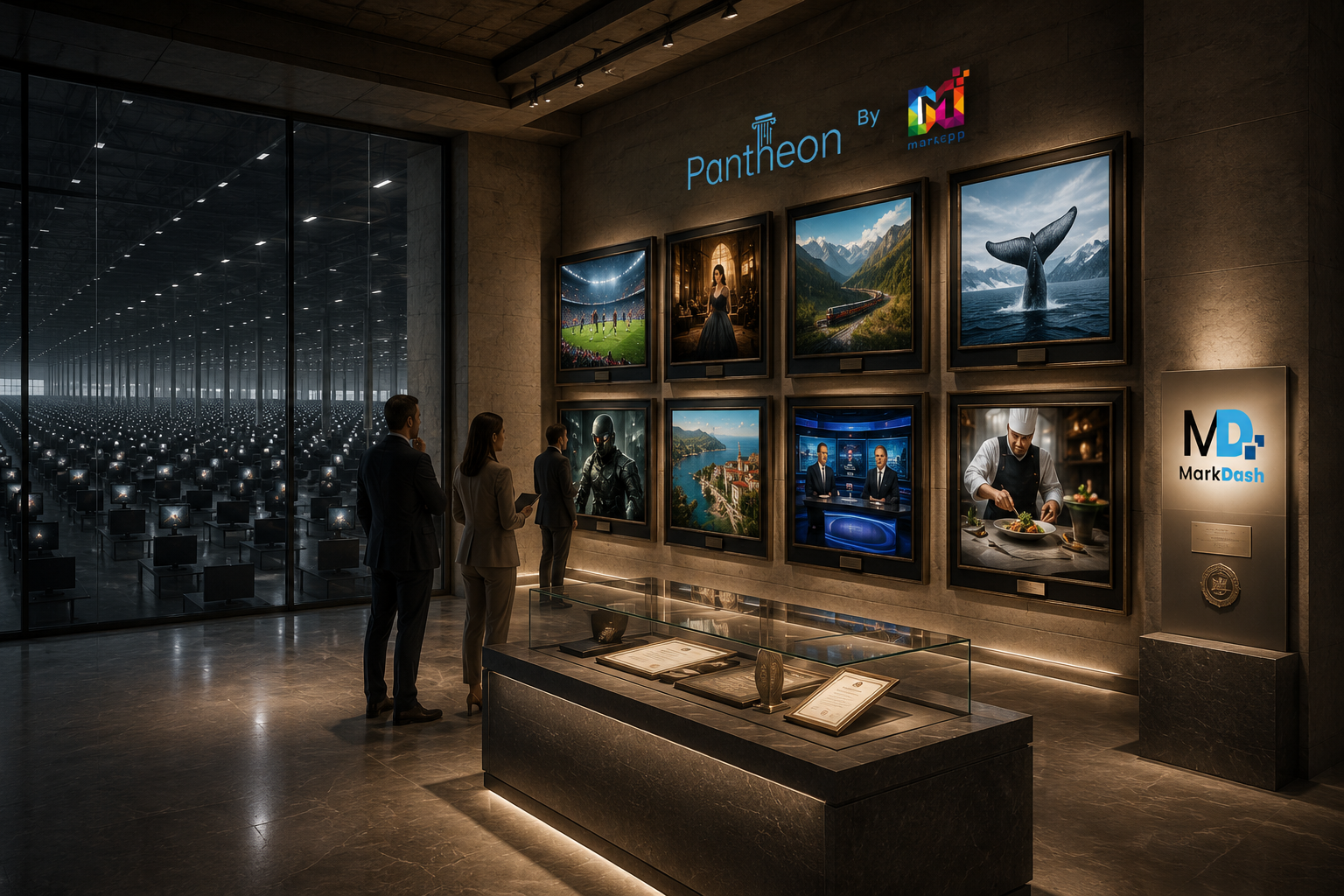
This is the heart of MarkApp’s thesis. Pantheon, our contextual SSP, qualifies premium supply across CTV, app and web before the auction, stream-native CTV inventory, brand-safety scoring and a five-vector contextual signal stack, all cookieless by design. It is built for precisely the conditions this tournament creates: massive, fragmented, privacy-constrained demand for premium attention.
From attention to outcomes: the retail media and commerce layer
Awareness is only half the tournament. The other half is conversion, and the 2026 World Cup is the first mega-event where the path from screen to purchase is being engineered in real time. Shoppable formats, real-time offers triggered by match events, and one-click purchase are all in play, with retail networks linking upper-funnel video spend directly to commerce outcomes during match weeks (The Current).
That closes the loop on the second-screen behaviour described above. A viewer watching the match on CTV, browsing on mobile, and buying in-app is no longer three separate audiences, it is one journey that can be activated and measured end-to-end. This is where Harion, our cross-device performance and commerce DSP, comes in: every bid enriched with Pantheon context before it leaves the platform, executing across CTV, app and web around the moments that matter — without requiring a single user identifier.
Where MarkApp fits in the World Cup window
MarkApp is not a sponsor, and that is the point. Official rights are scarce, expensive and limited to a handful of brands. The far larger opportunity is to activate around the tournament, aligning with match-related demand signals through premium contextual supply, without paying for sponsorship rights you do not need.
Our infrastructure is built for exactly this moment:
- Pantheon (SSP) — premium, curated, contextual supply across CTV, app and web. We don’t sell apps; we sell content environments. Stream-native CTV inventory, cookieless by design.
- Harion (DSP) — cross-device activation for performance and commerce, with Pantheon context wired in pre-auction. Premium over scale, contextual over identity.
- MarkDash (Ops) — unified, log-level reporting across every market and screen, so a multi-country World Cup campaign reads as one truth, not a dozen disconnected dashboards.
The combination is proven outside the tournament. In a recent EU campaign across six markets, contextual cohorts replaced third-party identity segments and delivered a 34% lower CPA, more than double the completed-video rate, and 92% post-bid viewability, on a weekly optimisation cadence, with no managed-service uplift. The same architecture is what a fragmented, privacy-first World Cup demands at scale.
The takeaway
The 2026 World Cup will be remembered in adtech not for the spot buys, but for the moment CTV, contextual targeting and retail media became the default rather than the experiment. The audience is enormous, but it is fragmented, multi-screen and increasingly cookieless. Winning it requires premium supply, contextual precision and a single measurement layer, not a sponsorship logo.
That is the infrastructure brands need for football’s biggest stage. It is also the infrastructure they will need for every screen, every market and every moment that follows.
Planning your World Cup 2026 activation across CTV, app and web? Talk with us about contextual, privacy-first execution that turns the world’s biggest audience into measurable outcomes.