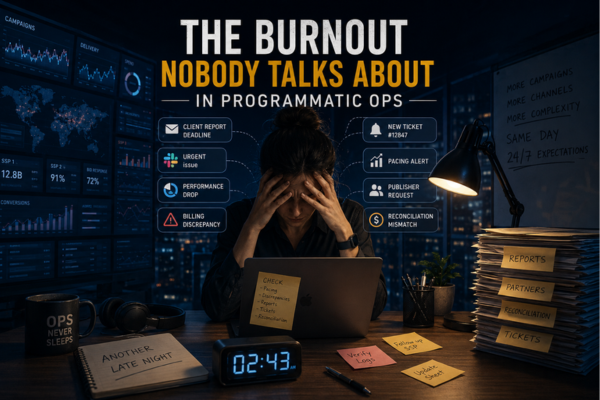
When people talk about burnout in advertising, they usually focus on sales teams, agencies, or creative departments.
Rarely do they talk about the teams sitting behind the dashboards.
The teams monitoring campaigns at midnight.
The teams troubleshooting delivery issues before clients notice them.
The teams reconciling data across multiple platforms, partners, and reports.
Programmatic Operations has become one of the most critical functions in digital advertising, and one of the most demanding.
The Invisible Work Behind Every Campaign
Most successful campaigns share something in common:
Nobody notices the operational work behind them.
When everything runs smoothly:
- campaigns deliver,
- reports reconcile,
- budgets pace correctly,
- publishers monetize,
- advertisers achieve their goals.
But achieving that consistency often requires continuous monitoring and intervention.
Programmatic operations has evolved from campaign management into infrastructure management.
Why Burnout Is Growing
The challenge is not a lack of talent.
The challenge is the increasing complexity of the ecosystem.
Today’s operations teams manage:
- Multiple SSPs and DSPs
- CTV, mobile app, and web environments
- Supply path optimization initiatives
- IVT monitoring
- Financial reconciliation
- Reporting requests
- Technical integrations
- Platform troubleshooting
At the same time, expectations continue to rise.
Everything must happen:
- faster,
- more accurately,
- and with complete transparency.
The Problem Isn’t Workload — It’s Fragmentation
Most operations professionals are not overwhelmed because they work hard.
They are overwhelmed because information is fragmented.
A typical day often involves switching between:
- DSP dashboards
- SSP reports
- Billing spreadsheets
- Slack messages
- Email threads
- Platform tickets
- Publisher requests
- Client updates
The result is operational fatigue caused by constant context switching.
The Cost of Operational Burnout
Burnout doesn’t only impact people.
It impacts performance.
When teams spend their time manually collecting information instead of making decisions, organizations experience:
- Slower optimization cycles
- Delayed issue detection
- Reporting inconsistencies
- Reduced efficiency
- Higher operational risk
The industry often talks about media efficiency while overlooking operational efficiency.
The two are directly connected.
The Industry’s Next Challenge: Operational Scalability
As programmatic continues to grow, scalability is no longer only a technology problem.
It is an operational problem.
Companies can add:
- more inventory,
- more partners,
- more campaigns,
- and more markets.
But eventually, operations teams become the bottleneck if processes remain manual.
The next phase of growth requires reducing complexity, not adding more of it.
People Are Part of the Infrastructure
Technology often gets the spotlight in programmatic advertising, but operational resilience is built by people.
Behind every campaign launch, troubleshooting request, reporting cycle, and optimization decision are teams working across multiple platforms, time zones, and stakeholders to keep the ecosystem running smoothly.
As the industry continues to scale, organizations must focus not only on platform performance, but also on creating sustainable operational environments for the teams managing them.
Giannis Spiropoulos, Chief Operations Officer at MarkApp, commented:
“In ops, we celebrate speed and uptime. We should also celebrate the team structures that make both sustainable.”
The future of programmatic operations is not only about automation and efficiency. It is also about building processes, systems, and teams that can scale without sacrificing performance or well-being.
How Automation Changes the Equation
The most effective operations teams are shifting from manual workflows to intelligent automation.
The goal is not replacing people.
The goal is allowing people to focus on decisions instead of administration.
Automation can help with:
- Alerting and anomaly detection
- Reporting consolidation
- Billing workflows
- Performance monitoring
- Reconciliation processes
This transforms operations from reactive management into proactive optimization.
How We Approach Operations at MarkApp
As our global activity across CTV, mobile apps, and web continues to grow, we have learned that operational efficiency is just as important as media efficiency.
This is one of the reasons we built MarkDash.
By centralizing reporting, analytics, alerts, and operational workflows into a single environment, we aim to reduce fragmentation and provide teams with a single source of truth.
The objective is simple:
Less time searching for information.
More time making decisions.
What Comes Next
The future of programmatic operations will not be defined by who can manage the most dashboards.
It will be defined by who can eliminate the need for them.
The companies that invest in operational intelligence, automation, and workflow simplification will be better positioned to scale efficiently while maintaining quality and transparency.
Final Perspective
Programmatic advertising has spent years optimizing media buying.
The next opportunity is optimizing the people and processes behind it.
Because the burnout nobody talks about isn’t caused by the volume of campaigns.
It’s caused by the complexity required to manage them.
And solving that challenge may become one of the most important competitive advantages in AdTech.